
Padel for kids, step by step: lessons, gear and safety basics, plus how a parent signs a child up with a PadelDropIn junior account and who sees their details.
Your child has been watching you play, picked up a racket during a break, and now wants to know when it's their turn. The questions follow quickly: where to start, what they need, who will coach them, and how to sign them up for a lesson or a tournament without sharing their details with the whole world. This guide walks through all of it.
Short answer: padel for kids is easiest to start at a club, in a kids' group or with a coach, using a borrowed racket, proper court shoes and the mandatory wrist strap. Once your child is playing, you can create a junior account in the PadelDropIn app and use it to sign them up for lessons, open matches and club events. Medical details are visible to a small, defined circle, and nobody can message a junior.
Contents
- Why padel is a friendly first sport
- How to get your child started
- Junior accounts in PadelDropIn
- What you can sign your child up for
- Who can see your child's details?
- When they grow up: their own login at 16
- Questions parents ask
- How to get started
Why padel is a friendly first sport
Padel is played in pairs — two against two — on an enclosed 20 × 10 metre court with glass walls and mesh fencing. The ball stays in play after it bounces off the wall, so rallies are often easier to keep going even when shots aren't yet accurate. For a child who is just learning, that usually means more balls in play.
Playing in a pair also has a social side: there's always someone next to you, so kids get used to working with a partner rather than only chasing their own result. The basics — an underarm serve, and the fact that an incoming ball must bounce on the floor before it hits a wall — are covered in our guide to the basic rules of padel.
Whether padel is right for your child, and when, is best judged together with a coach at the club and, if you have any health concerns at all, with your child's doctor. This article doesn't give medical advice.
How to get your child started
A kids' group or a coach
The simplest first step is to ask at a club whether they run a kids' group or have a coach who works with children. A coach sets the foundations — grip, movement, playing off the wall — and quickly sees what comes naturally and what needs practice. You arrange the time and pay for the lesson directly with the club or coach. You can browse clubs on our padel clubs page.
Gear: borrow before you buy
There's no need to buy anything expensive for the first lessons. Ask the club whether they rent or lend rackets, and let your child try before you decide whether their own is worth it. When it's time to buy, read how to choose a padel racket — it explains what to look for in shape, weight and materials.
Safety: shoes and the wrist strap
Two things matter from day one:
- Court shoes. Padel is full of short sideways movements, so ask the club or coach what footwear suits their surface.
- The wrist strap. Under the International Padel Federation (FIP) rules, the cord attached to the racket handle and worn around the wrist is mandatory. Your partner is always close by, so a racket that slips out of a hand can hit someone — make the strap a habit from the very first shot.
It also helps if kids learn court manners early: a greeting, returning balls, waiting while the next court finishes a point. More on that in padel etiquette: the unwritten rules.
Junior accounts in PadelDropIn
Once your child plays regularly, the organising becomes a job of its own: lessons, matches with other kids, club tournaments. That's what junior accounts in the PadelDropIn app are for — profiles for children, managed by a parent or guardian.
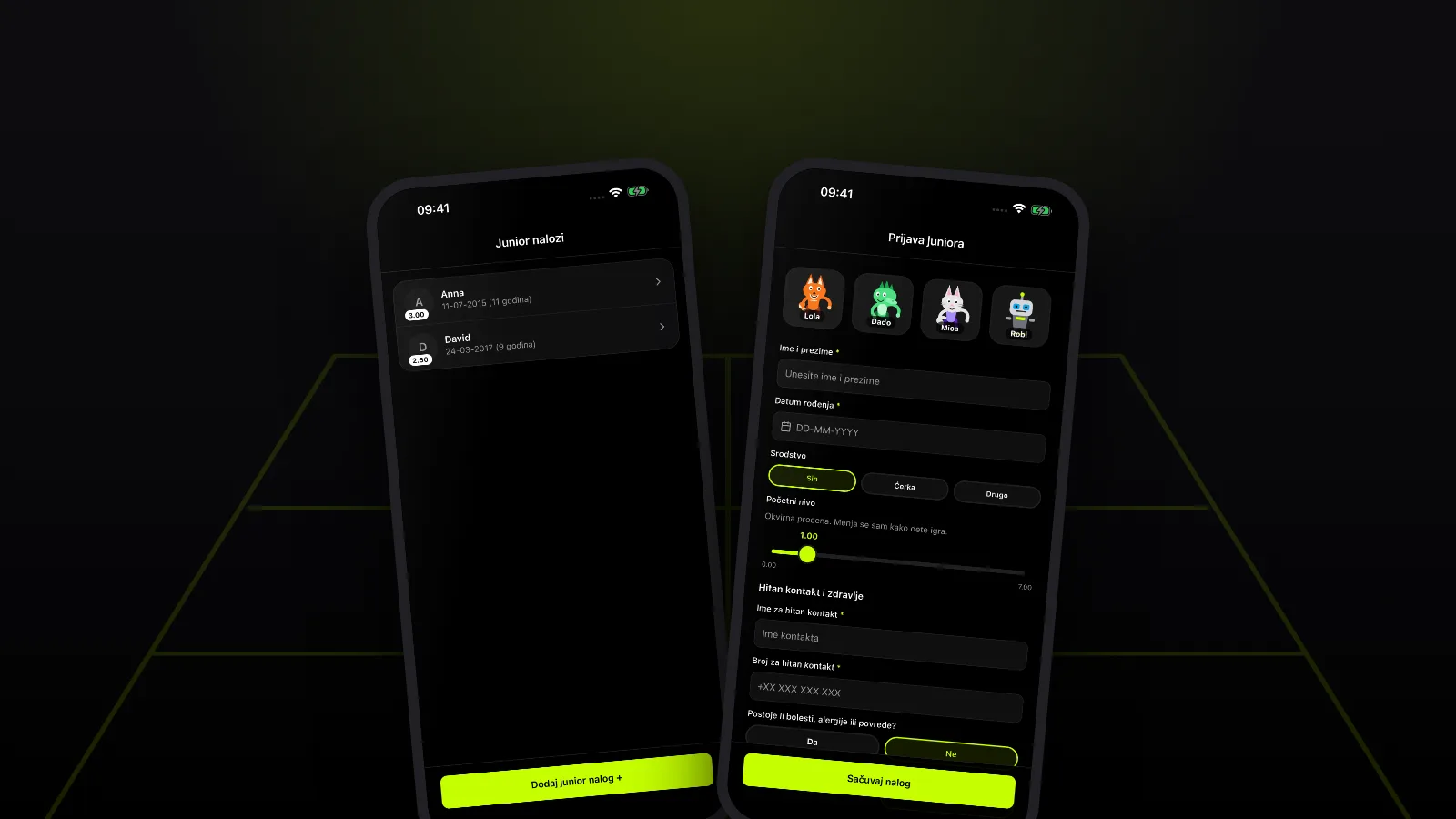
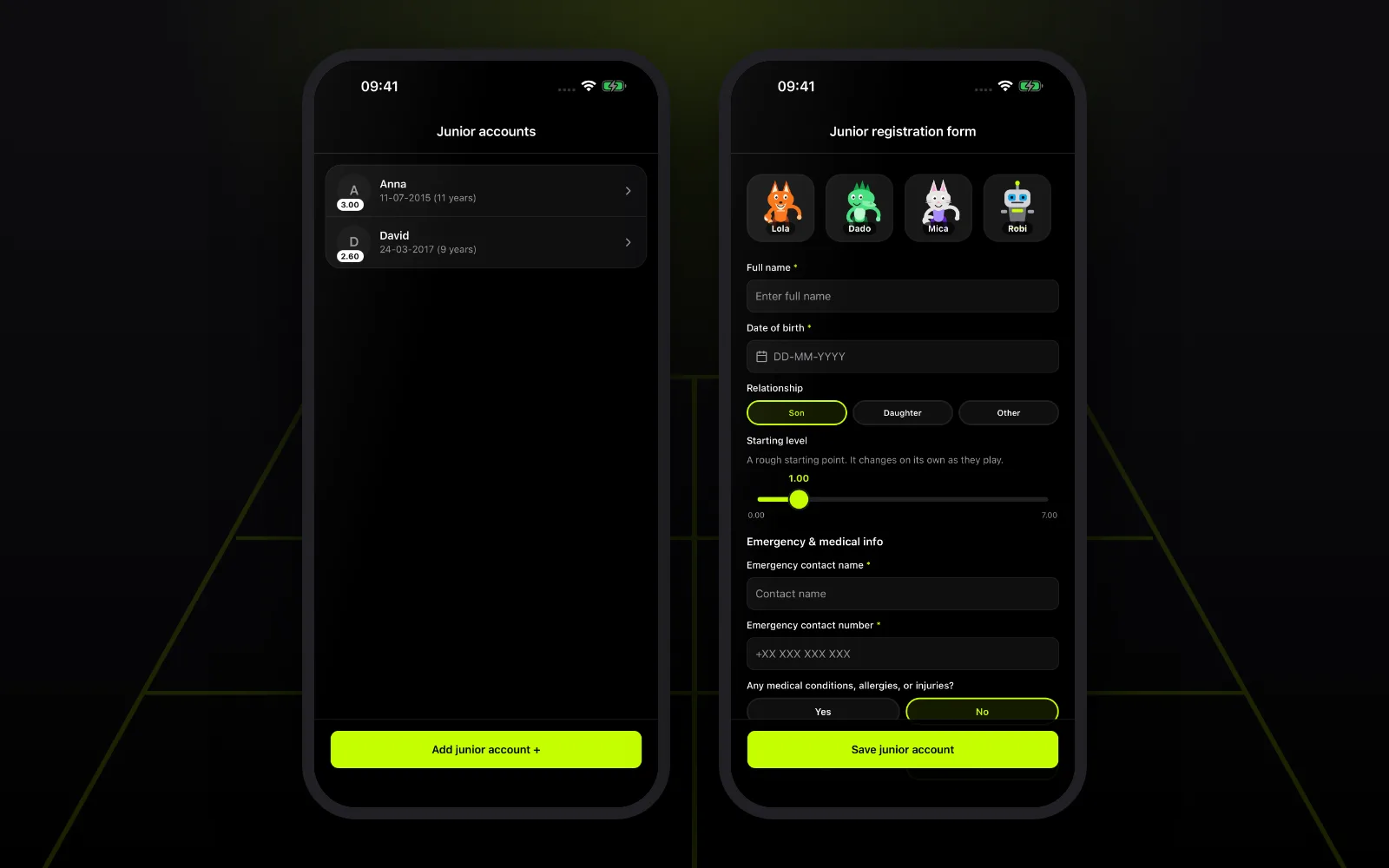
You create one from your own profile: Profile → "Junior accounts" → "Add junior account". The form asks for:
- your child's name and date of birth,
- your relationship (son, daughter or other),
- a starting level,
- an emergency contact — name and phone number,
- any medical conditions and medication.
The account is only saved once you tick the box confirming you are the child's parent or legal guardian. Junior accounts are for children aged 3 to 17, and one guardian can manage up to six.
Instead of a photo, the avatar is one of 12 illustrated mascots — fox, dino, cat, robot, bear, bunny, panda, shark, owl, tiger, unicorn or rocket. Real photos of children aren't used.
What you can sign your child up for
Whenever you join something in the app, you'll see "Who is joining?" — pick yourself or one of your juniors. That way you can enter your child into:
- club events and tournaments — individually, on the waitlist or as a pair; if an event has a minimum or maximum age, the app enforces it,
- open matches (a match someone posts so that the missing players can join),
- lessons and lesson requests to a coach.
If plans change, you withdraw them the same way. Notifications about your child come to you, with your child's name on them, so you always know who they're about. For how open matches work in general, see how to find padel partners and set up an open match.
One thing to know: the app doesn't take payments. Lessons and tournament fees are paid at the club or to the organiser, as before.
Who can see your child's details?
This is what parents ask about most, so here are the rules plainly.
Everyone can see only your child's name, mascot avatar and level — on rosters, the leaderboard and in search.
The emergency contact and medical notes are visible only to:
- you, as the guardian,
- the club running an event your child is entered in — until 30 days after the event,
- the coach, while a lesson booking or request is active and for 30 days after,
- platform admins.
Nobody can message a junior. There are no direct messages, group chats or event chats with a junior account.
When they grow up: their own login at 16
Once your child turns 16, the junior account offers "Create their own login". You enter your teenager's email, they get an invitation and set their own password. It stays the same profile and their match history carries over, while the medical details are deleted as part of the switch.
Questions parents ask
Can I manage more than one child? Yes — one guardian can have up to six junior accounts.
What if my child stops playing? You can archive the junior account, which keeps their history. Deleting is only possible if the child has no play history.
Do other players see the medical notes? No. Other players see only the name, mascot and level.
How to get started
- Ask at a club about a kids' group or a coach and arrange the first lesson.
- Borrow a racket, sort out court shoes and check the wrist strap.
- Download the PadelDropIn app and open "Junior accounts" in your profile.
- Create the junior account, pick a mascot and fill in the emergency contact.
- When joining a lesson, match or event, choose your child under "Who is joining?".
PadelDropIn is currently active in Belgrade, and the club network is gradually expanding across the region. For more guides, visit the PadelDropIn blog.
Sources
- Rules of Padel — International Padel Federation (FIP) — 20 × 10 m court, doubles play and the mandatory wrist strap. Checked 2 October 2026.
Download PadelDropIn
Find open matches, clubs, and padel partners in your city — free for players.